what compromises were proposed in the colonies as alternatives to independence

15d. Constitution Through Compromise
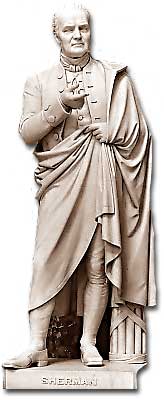
Roger Sherman was the only man to sign all iv of the important Revolutionary documents: The Association of 1774, the Declaration of Independence, the Manufactures of Confederation, and the Constitution.
"Representation" remained the core event for the Philadelphia Convention. What was the best style for authority to be delegated from the people and the states to a strengthened central government?
Afterwards still more than deeply divided argument, a proposal put forward by delegates from Connecticut (a pocket-size population state ), struck a compromise that narrowly got approved. They suggested that representatives in each firm of the proposed bicameral legislature be selected through different means. The upper house (or Senate) would reverberate the importance of country sovereignty by including two people from each country regardless of size. Meanwhile, the lower firm (the Firm of Representatives) would have dissimilar numbers of representatives from each country determined past population. Representation would be adapted every ten years through a federal demography that counted every person in the state.
By coming upward with a mixed solution that balanced state sovereignty and popular sovereignty tied to actual population, the Constitution was forged through what is known every bit the Connecticut Compromise. In many respects this compromise reflected a victory for pocket-sized states, but compared with their authority in the Congress under the Articles of Confederation it is clear that negotiation produced something that both small and large states wanted.
Other major issues still needed to be resolved, even so, and, over again, compromise was required on all sides. 1 of the major issues concerned elections themselves. Who would be allowed to vote? The unlike state constitutions had created dissimilar rules most how much property was required for white men to vote. The delegates needed to figure out a solution that could satisfy people with many different ideas virtually who could take the franchise (that is, who could exist a voter).
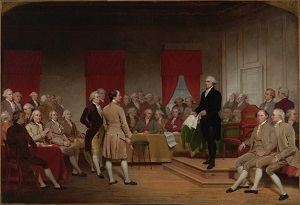
Washington every bit Statesman at the
Constitutional Convention
Junius Brutus Stearns, 1856
For the popular lower house, any white man who paid taxes could vote. Thus, fifty-fifty those without property, could vote for who would represent them in the House of Representatives. This expanded the franchise in some states. To balance this opening, the two Senators in the upper house of the national government would be elected past the state legislatures. Finally, the President (that is, the executive branch) would be elected at the state level through an electoral college whose numbers reflected representation in the legislature.
To modern eyes, the most stunning and disturbing constitutional compromise by the delegates was over the effect of slavery. Some delegates considered slavery an evil establishment and George Mason of Virginia fifty-fifty suggested that the trans-Atlantic slave trade be made illegal by the new national rules. Delegates from South Carolina and Georgia where slavery was expanding rapidly in the belatedly-18th century angrily opposed this limitation. If any limitations to slavery were proposed in the national framework, then they would get out the convention and oppose its proposed new programme for a stronger central regime. Their fierce opposition immune no room for compromise and as a upshot the result of slavery was treated as a narrowly political, rather than a moral, question.
The delegates agreed that a strengthened union of usa was more than important than the Revolutionary platonic of equality. This was a businesslike, as well as a tragic, ramble compromise, since it may have been possible (as suggested by George Bricklayer'due south comments) for the slave state of Virginia to take some limitations on slavery at this bespeak.
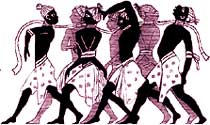
The slave trade was always a controversial event in the history of the Usa.
The proposed constitution actually strengthened the power of slave states in several important respects. Through the "fugitive clause," for case, governments of free states were required to help recapture runaway slaves who had escaped their masters' states. Every bit agonizing was the "3-fifths formula" established for determining representation in the lower house of the legislature. Slave states wanted to have additional political power based on the number of human beings that they held as slaves. Delegates from complimentary states wouldn't permit such a breathy manipulation of political principles, merely the inhumane compromise that resulted meant counting enslaved persons as iii-fifths of a free person for the sake of calculating the number of people a state could elect to the House of Representatives.

Afterwards hot summer months of difficult contend in Philadelphia from May to September 1787, the delegates had fashioned new rules for a stronger central authorities that extended national power well across the scope of the Articles of Confederation. The Constitution created a national legislature that could laissez passer the supreme law of the land, could enhance taxes, and with greater control over commerce. The proposed rules also would restrict land actions, specially in regard to passing pro-debtor laws. At the end of the long process of creating the new plan, thirty-eight of the remaining forty-one delegates showed their support by signing the proposed Constitution. This small group of national superstars had created a major new framework through difficult piece of work and compromise.
Now some other challenge lay ahead. Could they convince the people in u.s.a. that this new program was worth accepting?
QUIZ Time: Constitution Quiz

If you like our content, delight share information technology on social media!


Source: https://www.ushistory.org/us/15d.asp
0 Response to "what compromises were proposed in the colonies as alternatives to independence"
Post a Comment