Can You Have Perfect Pitch and Not Know It

How Tin You Tell If You Take Perfect Pitch?
Some famous musicians—from Mariah Carey to Jimi Hendrix—have a gift known as perfect pitch. What is information technology? Could you take it, too?
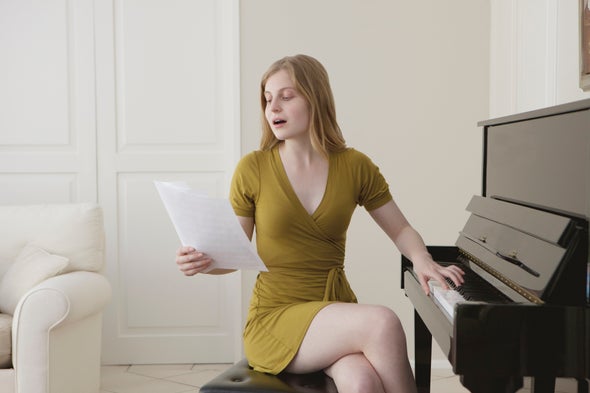

Mariah Carey, Ella Fitzgerald, Bing Crosby, Mozart, Beethoven, Jimi Hendrix, and Yanni. What do these musicians have in common? They're all said to take perfect pitch.
How rare is perfect pitch? If y'all don't have information technology already, can you learn it?
What is perfect (or absolute) pitch?
Perfect pitch (technically known as absolute pitch) is the ability to identify, without effort, the pitch of a note.
Let's say someone plays a D on the piano. A person with perfect pitch—and the musical training to be able to name the notes—would be able to identify the annotation as a D without any reference. Or they might hear a note played and be able to reproduce it on an musical instrument without having to search for it. If you told someone who had vocal training and perfect pitch to sing a D, they'd be able to do it easily.
When someone can place a notation simply when it's based on a reference notation, that'due south called relative pitch. People with perfect pitch, on the other hand, don't demand a reference notation to characterization an audible tone correctly.
How rare is perfect pitch?
Out of every ten,000 people, merely between 1 to 5 of them will have perfect pitch. Out of every 10,000 musicians, however, between 100 and 1100 (that'south 1-xi%) may take the gift. Perfect pitch is also observed to run in families, which suggests it'south at least partially genetic.
Perfect pitch is more common in cultures where the linguistic communication is tonal. In tonal languages, the same discussion said in different tones has different meanings. (That's compared to cultures where tone indicates emotion and non pregnant.) 1 written report of music students found that 60 percent of Mandarin-speaking students who had studied music since the historic period of iv or five had perfect pitch relative to just 14 percent of English language-speaking students.
Some scientists fence that this could mean perfect pitch can be taught. That's especially true for someone who learns to alter and identify pitch from a immature age, similar when they're learning to speak their first language.
Other studies have shown that perfect pitch is more common among people with autism. I report of children historic period 7 to 13 found that those with autism were better able to tell apart ii subtlely different tones and to think melodies weeks subsequently than neurotypical children in the same age group. This link is peculiarly intriguing because understanding perfect pitch may help us empathise the genetic links to autism as well as possible handling therapies.
Investigations into actual anatomical differences have found that the brains of people with perfect pitch wait different. They have more grey matter in the expanse of the brain we suspect is responsible for identifying pitch, the right auditory cortex. Their right auditory cortex and their prefrontal cortex, also associated with music processing, is also thicker, suggesting more brain activeness there.
Interestingly, if you accept perfect pitch, it's plainly hard to understandnothaving it. (I say "evidently" because I was not gifted with such a high-functioning ear.)
To sympathize why this is, an analogy to color is often used. Imagine someone who can see all the colors and tell them apart but tin can't tell you if something is "yellowish" or "blue" unless they were shown a reference colour similar "cherry-red" first. For those of us who see colour, this makes no sense! The aforementioned goes for those with perfect pitch when they try to sympathise why the rest of us tin't label a note when nosotros hear it on its ain. In the color analogy, a person with perfect pitch could look at a shade of blueish on someone's sweater and and so go to a paint store and find the exact shade from retentiveness.
So why is the power to differentiate something like color so mutual but accented pitch so rare? Ane group has suggested that possibly some component of perfect pitchismore than common—let's call information technology non-quite-perfect-but-better-than-merely-capable-of-relevant pitch.
Work led by Dr. Elizabeth Margulis at the University of Arkansas suggests that fifty-fifty people without any formal music grooming can testify signs of some aspect of absolute pitch. For instance, they might be able to pick out individual notes that are off-central more easily for familiar scales similar C-major (call back the white keys on the piano) versus less common scales like those in D-flat major (generally black pianoforte keys).
Margulis and her team also find that our power to rails absolute pitch may affect how emotional nosotros experience when listening to music. Participants in the study reported that the music felt tenser when information technology contained notes that were in the wrong key.
»Continue reading "How Tin Yous Tell If You Take Perfect Pitch?" on QuickAndDirtyTips.com

Source: https://www.scientificamerican.com/article/how-can-you-tell-if-you-have-perfect-pitch/
0 Response to "Can You Have Perfect Pitch and Not Know It"
Post a Comment